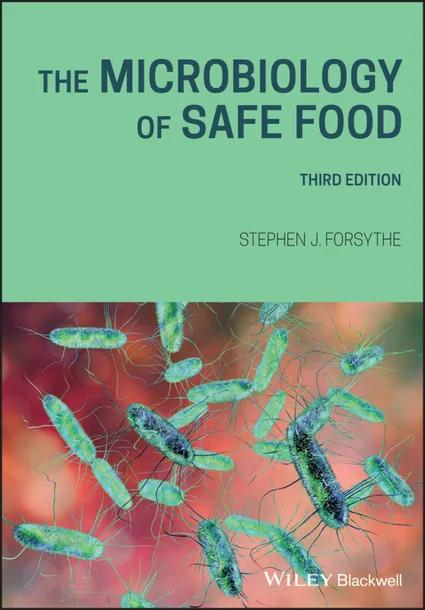
The Microbiology of Safe Food
by Stephen J. Forsythe
3rd Edition
Publisher: Wiley-Blackwell
Book Details
| Print ISBN | 9781119405016 |
| eText ISBN | 9781119405535 |
| Publisher | Wiley-Blackwell |
| Publishing Year | 2019 |
| Edition | 3rd Edition |
| Language | English |
| Pages | 624 |
The Microbiology of Safe Food, 3rd Edition, is a textbook by Stephen J. Forsythe examining the biological processes and public health effects of food microbiology. The work investigates both foodborne pathogens and spoilage organisms, highlighting practices essential to producing safe food.
The volume explores microbial growth, preservation techniques, and foodborne hazards including bacteria, viruses, parasites, toxins, and prions. It connects these subjects to practical controls such as hygiene regulations, product testing, microbiological criteria, sampling plans, and microbiological risk assessment.
The 2019 edition added material on high-throughput sequencing, genomic epidemiology, and genomic analysis for key organisms. It also reviews foodborne outbreak investigations illustrating the public health costs of unsafe production, alongside surveillance systems that incorporate social media.
Table of Contents
Chapter 1: Foodborne infections
- • 1.1 The microbial world and its relationship to food
- • 1.2 Origins of safe food production
- • 1.3 Overview of foodborne illness
- • 1.4 Public perception of safe food
- • 1.5 Causes of foodborne illness
- • 1.6 Food poisoning due to common food commodities
- • 1.7 Host‐related issues
- • 1.8 Hygiene hypothesis
- • 1.9 Chronic sequelae following foodborne illness
- • 1.10 The size of the foodborne illness problem
- • 1.11 The cost of foodborne diseases
- • 1.12 Changes in antimicrobial resistance of foodborne pathogens
- • 1.13 Food safety following natural disasters, and conflict
- • 1.14 Food microbiology, foodborne diseases and climate change
Chapter 2: Basic aspects
- • 2.1 The human intestinal tract
- • 2.2 The normal human intestinal flora
- • 2.3 Host resistance to foodborne infections
- • 2.4 Bacterial cell structure
- • 2.5 Bacterial toxins and other virulence determinants
- • 2.6 Microbial growth cycle
- • 2.7 Death kinetics
- • 2.8 Factors affecting microbial growth
- • 2.9 Microbial response to stress
- • 2.10 Predictive modelling
Chapter 3: Food preservation and spoilage organisms
- • 3.1 Spoilage micro‐organisms
- • 3.2 Shelf life indicators
- • 3.3 Methods of preservation and shelf life extension
- • 3.4 Preservatives
- • 3.5 Physical methods of preservation
- • 3.6 Packaging
- • 3.7 Fermented food products
- • 3.8 Organisms involved in the production of fermented foods
- • 3.9 Functional foods: probiotics and gut modulation
Chapter 4: Bacterial foodborne pathogens
- • 4.1 Indicator organisms
- • 4.2 Campylobacter jejuni, C. coli and C. lari
- • 4.3 Salmonella serovars
- • 4.4 Pathogenic E. coli
- • 4.5 Sh. dysenteriae and Sh. sonnei
- • 4.6 Cronobacter species
- • 4.7 Vibrio cholerae, V. parahaemolyticus and V. vulnificus
- • 4.8 Brucella melitensis, Br. abortus and Br. suis
- • 4.9 Yersinia enterocolitica
- • 4.10 Aeromonas hydrophila, A. caviae and A. sobria
- • 4.11 Plesiomonas shigelloides
- • 4.12 Listeria monocytogenes
- • 4.13 Staphylococcus aureus
- • 4.14 Clostridium perfringens
- • 4.15 Clostridium botulinum
- • 4.16 B. cereus group
- • 4.17 Enterococcus and Streptococcus species
- • 4.18 Emerging and uncommon foodborne pathogens
Chapter 5: Foodborne pathogens: viruses, toxins, parasites and prions
- • 5.1 Foodborne viruses
- • 5.2 Seafood and shellfish poisoning
- • 5.3 Foodborne parasites: eucaryotes
- • 5.4 Mycotoxins
Chapter 6: Methods of detection and characterisation
- • 6.1 Prologue
- • 6.2 Conventional methods
- • 6.3 Rapid sampling methods
- • 6.4 Rapid end‐detection methods
- • 6.5 DNA‐based molecular typing and proteomic methods
- • 6.6 Identification and typing methods based on high‐throughput DNA sequencing
- • 6.7 Specific detection procedures and accreditation
Chapter 7: Microbiological criteria
- • 7.1 Background to microbiological criteria and end‐product testing
- • 7.2 International commission on microbiological specifications for foods (ICMSF)
- • 7.3 Codex Alimentarius principles for the establishment and application of microbiological criteria
- • 7.4 Sampling plans
- • 7.5 Variables plans
- • 7.6 Attributes sampling plan
- • 7.7 Principles
- • 7.8 Microbiological limits
- • 7.9 Implemented microbiological criteria
- • 7.10 UK guidelines for ready‐to‐eat foods
Chapter 8: Hygienic production practices
- • 8.1 Contribution of food handlers to foodborne illness
- • 8.2 Personnel hygiene and training
- • 8.3 Cleaning
- • 8.4 Detergents and disinfectants
- • 8.5 Microbial biofilms
- • 8.6 Assessment of cleaning and disinfection efficiency
Chapter 9: Food safety management tools
- • 9.1 The manufacture of hygienic food
- • 9.2 Microbiological safety of food in world trade
- • 9.3 Consumer pressure effect on food processing
- • 9.4 The management of hazards in food in international trade
- • 9.5 Hazard analysis critical control point (HACCP)
- • 9.6 Prerequisite programme
- • 9.7 Outline of HACCP
- • 9.8 Microbiological criteria and HACCP
- • 9.9 Microbiological hazards and their control
- • 9.10 HACCP plans
- • 9.11 GMP and GHP
- • 9.12 Quality systems
- • 9.13 Total quality management
Chapter 10: Microbiological risk assessment
- • 10.1 Risk analysis and microbiological risk assessment
- • 10.2 Origin of MRA
- • 10.3 MRA – an overview
- • 10.4 MRA – structure
- • 10.5 Risk assessment
- • 10.6 Risk management
- • 10.7 Food safety objectives (FSO)
- • 10.8 Risk communication
- • 10.9 Future developments in MRA
Chapter 11: Application of microbiological risk assessment
- • 11.1 Salmonella serovars
- • 11.2 Campylobacter
- • 11.3 L. monocytogenes
- • 11.4 E. coli O157
- • 11.5 Bacillus cereus
- • 11.6 Vibrio parahaemolyticus
- • 11.7 Cronobacter species and Salmonella in powdered infant formula (PIF)
- • 11.8 Viral risk assessments
Chapter 12: International control of microbiological hazards in foods: regulations and authorities
- • 12.1 Control of foodborne pathogens
- • 12.2 World Health Organisation (WHO), global food security from accidental and deliberate contamination
- • 12.3 Regulations in international trade of food
- • 12.4 Codex Alimentarius Commission (CAC)
- • 12.5 SPS measures, Technical Barriers to Trade (TBT) and the WHO
- • 12.6 EU legislation
- • 12.7 International food safety agencies
Chapter 13: Surveillance and foodborne outbreak investigation
- • 13.1 Surveillance programmes
- • 13.2 Outbreak investigations
- • 13.3 Social media, crowd sourcing and reporting food poisoning cases
- • 13.4 Mobile phones and food safety
- • 13.5 Food terrorism and biocrimes
Chapter 14: Whole‐genome sequencing, microbiomes and genomic epidemiology
- • 14.1 High‐throughput DNA sequencing
- • 14.2 Microbiome analysis
- • 14.3 Genomic epidemiology
- • 14.4 Key outbreaks investigated using genomic epidemiology
Customer Reviews
0.0
0 reviews
No reviews yet. Be the first to review this book!
Write a Review
Reviewed by GradeFocus Editorial Team
Related Books
Edible Oil Blends
Mohamed Fawzy Ramadan
Interaction of Food Macromolecules
Ibrahim Khalifa
Food Engineering Automation with Robotics and AI
Abir Chakravorty
Non-Bovine Milk-Derived Bioactive Peptides
Subrota Hati
Advances in Edible Packaging Systems for Food Preservation
Zuhaib F. Bhat
Alternative Dairy Products and Technologies
Harjinder Singh